Character ArcPathways Enquire

The pathways · Pathway two · Years 7–12

The pathway to being understood

You can disagree with an idea and still respect the person.

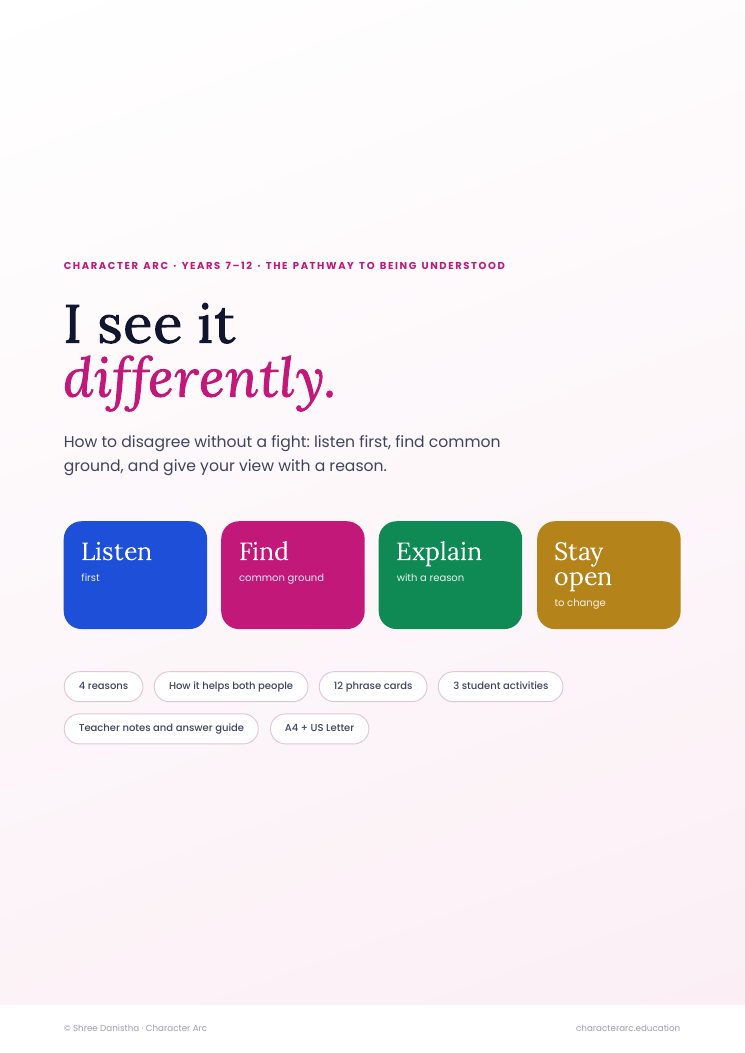
How to disagree without a fight: listen first, find common ground, and give your view with a reason. Written for young people in Years 7 to 12.
The four steps

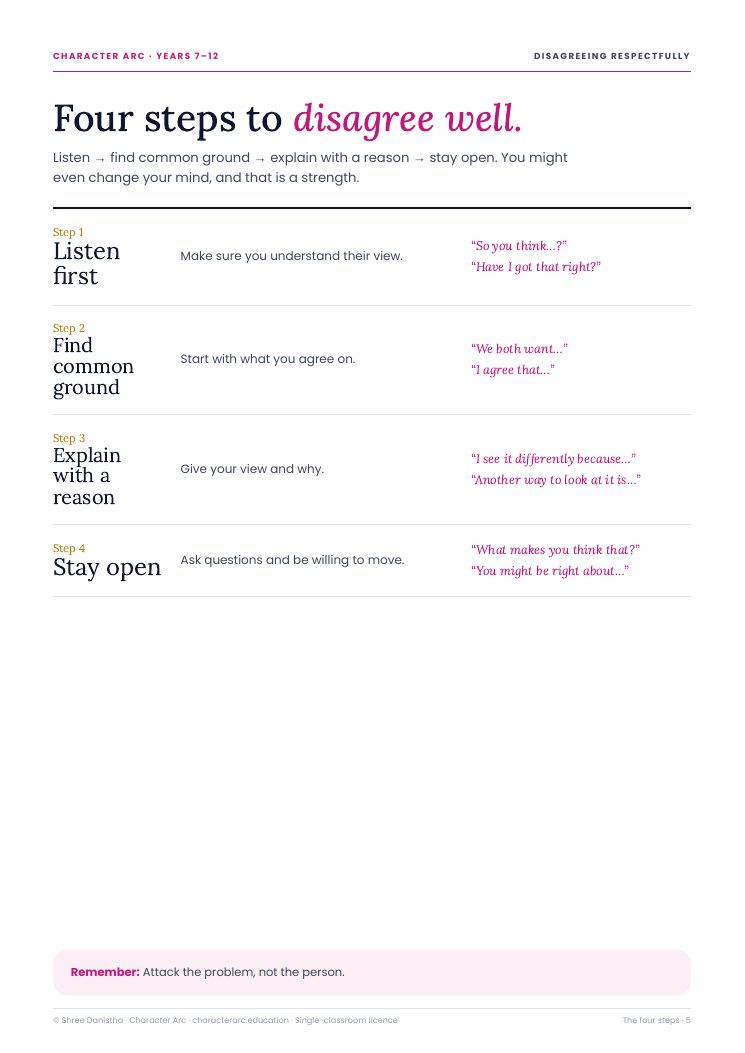
Four steps to disagree well.

Listen → find common ground → explain with a reason → stay open. You might even change your mind, and that is a strength.

Step 1

Listen first

Make sure you understand their view.

  • “So you think…?”
  • “Have I got that right?”
Step 2

Find common ground

Start with what you agree on.

  • “We both want…”
  • “I agree that…”
Step 3

Explain with a reason

Give your view and why.

  • “I see it differently because…”
  • “Another way to look at it is…”
Step 4

Stay open

Ask questions and be willing to move.

  • “What makes you think that?”
  • “You might be right about…”

RememberAttack the problem, not the person.

Why it matters

Why disagree well?

People see things differently. Learning to disagree well is one of the most useful skills there is, at school, at home and at work.

i.

Disagreement is normal

People see the world differently. Disagreement is how ideas get tested and improved.

ii.

Respect keeps people listening

When people feel attacked they stop hearing. When they feel respected, they keep listening.

iii.

Disagree with ideas, not people

You can think someone’s idea is wrong and still treat them with respect.

iv.

It leads to better decisions

Groups that disagree well make better choices than groups where nobody speaks up.

How it helps everyone

Good for one person. Better for both.

This skill is not only good for the person who uses it. It helps everyone involved, and the relationship between them.

For the one who disagrees

  • Gets heard
  • Stays true to their view
  • Builds confidence speaking up
  • Keeps their friendships

For the other person

  • Feels respected, not attacked
  • Hears a reason, not a put-down
  • Can change their mind without losing face
  • Learns something new

For both of them

  • Better ideas and decisions
  • Less fighting
  • Both learn it is safe to disagree
  • Trust grows
The words to use

Phrases young people can actually say.

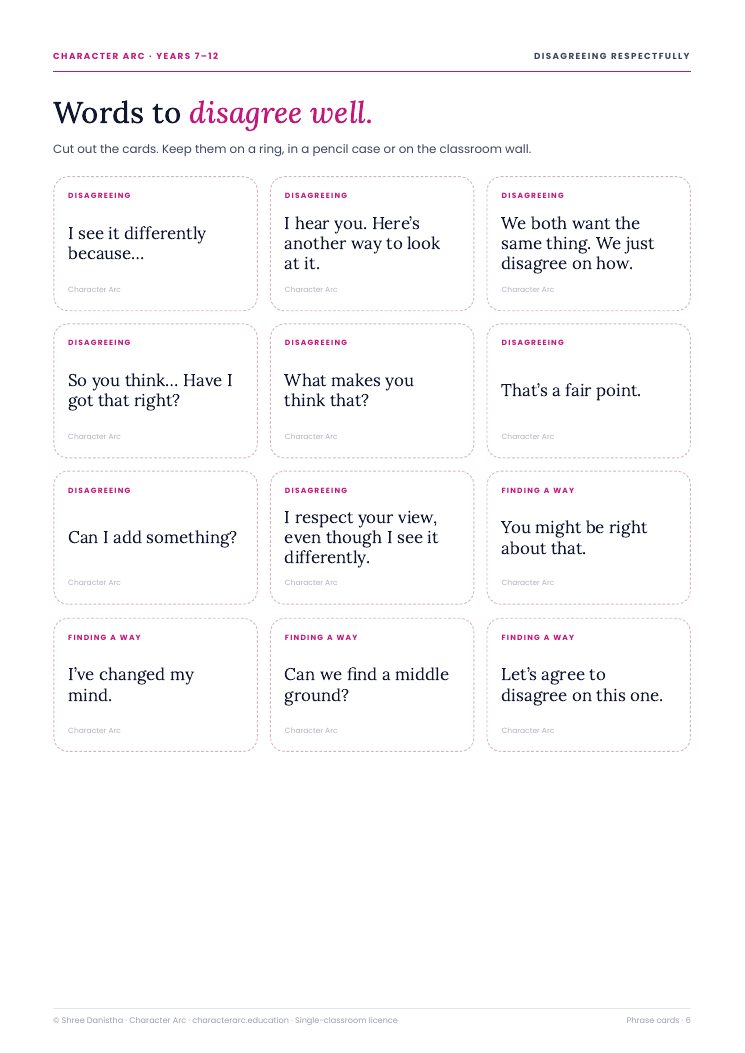
The pack includes twelve cut-out phrase cards. Here are some of them.
Disagreeing
  • I see it differently because…
  • I hear you. Here’s another way to look at it.
  • We both want the same thing. We just disagree on how.
  • So you think… Have I got that right?
  • What makes you think that?
  • That’s a fair point.
Finding a way
  • You might be right about that.
  • I’ve changed my mind.
  • Can we find a middle ground?
  • Let’s agree to disagree on this one.
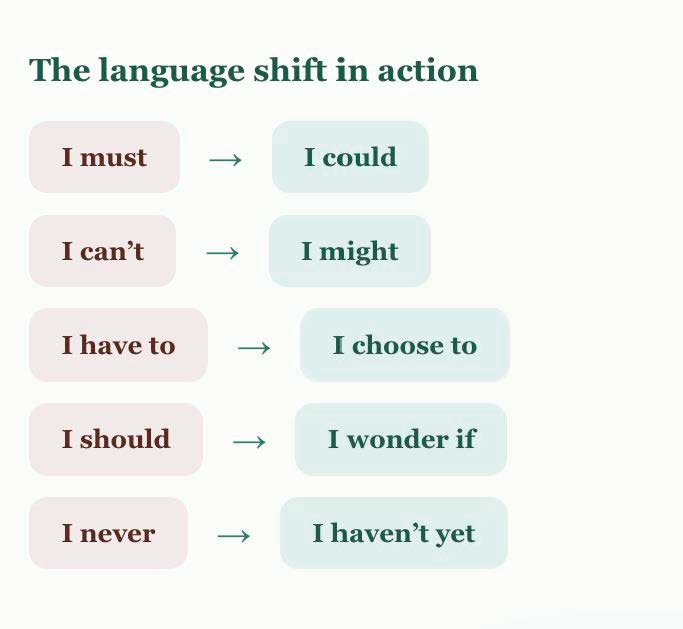
The language shift: I must to I could, I can't to I might, I have to to I choose to, I should to I wonder if, I never to I haven't yet
Softer words leave room for the other person.
At home and in class

How to use it.

Each activity takes about 15–20 minutes. Use the pack in a single lesson, in pastoral care or tutor group, or over a week at home.

Three activities, all built on fictional scenes:

  • 1Disagree well.
  • 2Rewrite the debate.
  • 3Respectful, or not yet?
Safety note. Disagreeing respectfully is about ideas and opinions. Disagreement never makes put-downs, threats or exclusion acceptable. If a disagreement turns into bullying, students should tell a trusted adult.
  1. Teach it calmlyIntroduce the four steps when everyone is settled, not in the middle of a conflict.
  2. Model the wordsUse the phrases yourself. Young people copy what they see and hear.
  3. Role-play the scenesAct out the fictional scenes in pairs, then swap roles.
  4. Keep the cards closePut the phrase cards on the wall, on a ring or in a pencil case.
  5. Debate warm-upsUse low-stakes topics first, such as the best pizza topping or the best season, so students practise the phrases before using them on topics that matter more.
What’s included

I see it differently.

Years 7–12 · 11 pages · A4 and US Letter

Disagreeing respectfully

A print-and-go pack for home, classroom and pastoral care.

Inside
Teacher and parent notes, four reasons why it matters, how it helps everyone, the four steps, 12 phrase cards, three activities and an answer guide
Privacy
Every activity uses fictional characters. Students never describe their own lives.
Format
Printable PDF, A4 and US Letter
Private by design
Practise the skill with fictional scenes. Use it in real life.

Every activity in this pack uses made-up characters and everyday situations, so young people can practise without sharing anything personal.

Ways to join

School licences & private membership.

Character Arc is available to schools and to families. Choose the way that suits you, and Shree will be in touch personally.

For schools

School licences available

Bring the pathways into your classrooms with one shared language for calm, clear words, character, feelings and connection.

  • Classroom licences
  • Whole-school licences
Enquire about a licence →
For families

Private website membership

A private membership to the Character Arc website for families who want to follow the pathways at home, at their child’s own pace.

  • Private access for your family
  • Set up personally by Shree
Enquire about membership →