Character ArcPathways Enquire

The pathways · Pathway five · Years 7–12

The pathway to grace toward others

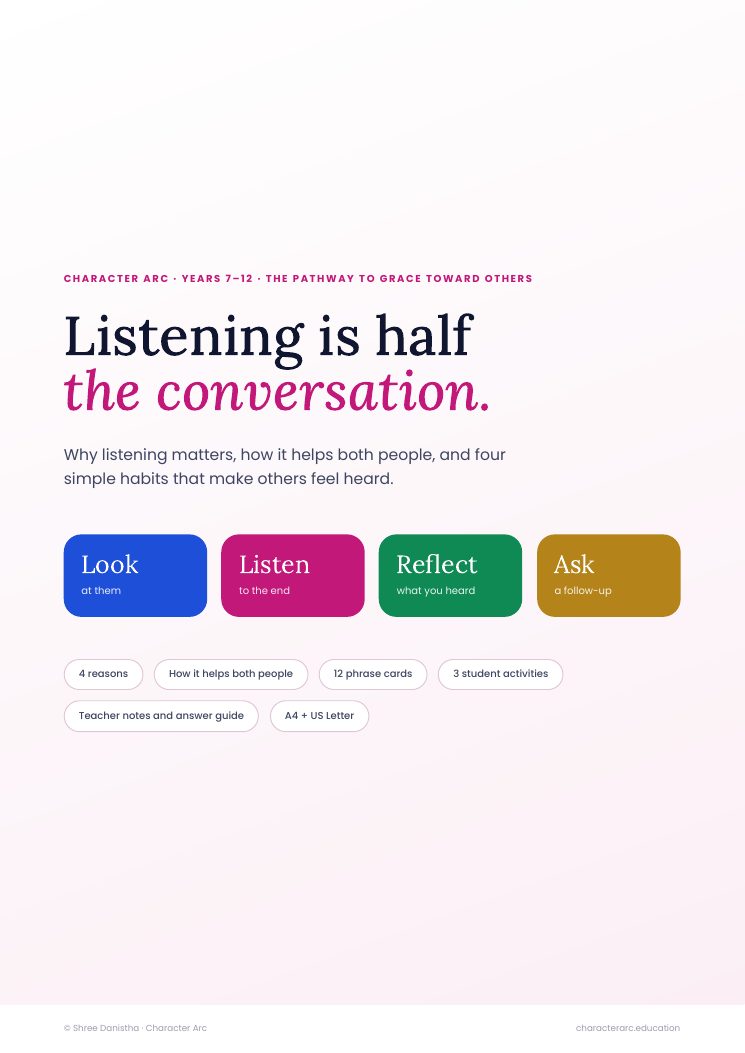
Listening is half of every conversation.

Why listening matters, how it helps both people, and four simple habits that make others feel heard. Written for young people in Years 7 to 12.
The four steps

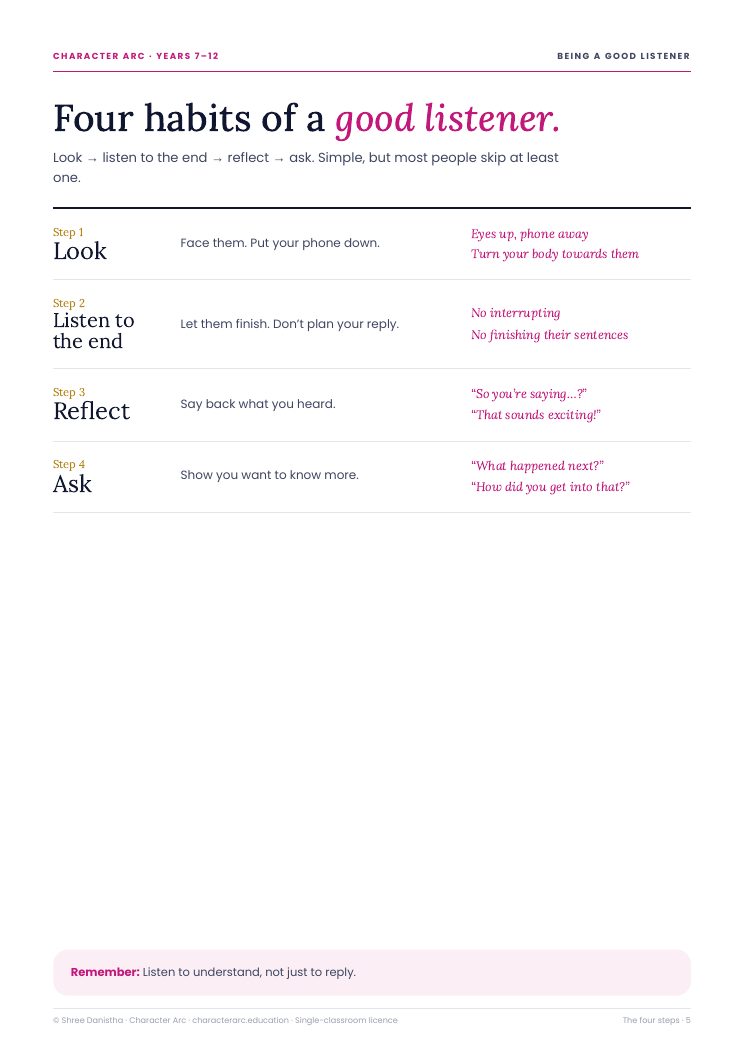
Four habits of a good listener.

Look → listen to the end → reflect → ask. Simple, but most people skip at least one.

Step 1

Look

Face them. Put your phone down.

  • Eyes up, phone away
  • Turn your body towards them
Step 2

Listen to the end

Let them finish. Don’t plan your reply.

  • No interrupting
  • No finishing their sentences
Step 3

Reflect

Say back what you heard.

  • “So you’re saying…?”
  • “That sounds exciting!”
Step 4

Ask

Show you want to know more.

  • “What happened next?”
  • “How did you get into that?”

RememberListen to understand, not just to reply.

Why it matters

Why listening matters

Most people are waiting to talk. Someone who really listens stands out, and people remember how they made them feel.

i.

Everyone wants to be heard

Being listened to makes people feel valued and understood.

ii.

It builds friendships

People trust and return to those who listen to them.

iii.

You learn more

You can’t learn anything new while you are talking.

iv.

It prevents misunderstandings

Listening properly means fewer mix-ups and fewer arguments.

How it helps everyone

Good for one person. Better for both.

This skill is not only good for the person who uses it. It helps everyone involved, and the relationship between them.

For the listener

  • Understands people better
  • Makes friends more easily
  • Avoids misunderstandings
  • Learns new things

For the speaker

  • Feels valued
  • Can think out loud
  • Feels less alone
  • Is more likely to listen back

For both of them

  • Conversations go deeper
  • Fewer arguments
  • Friendships grow
  • Both feel respected
The words to use

Phrases young people can actually say.

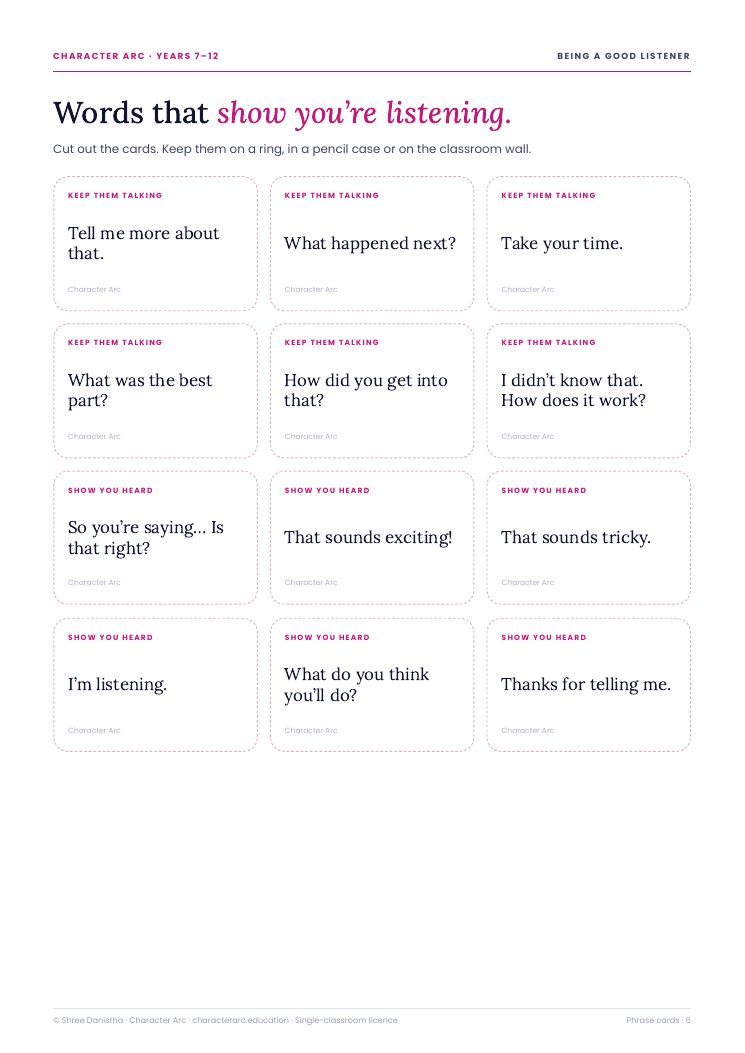
The pack includes twelve cut-out phrase cards. Here are some of them.

Keep them talking
  • Tell me more about that.
  • What happened next?
  • Take your time.
  • What was the best part?
  • How did you get into that?
  • I didn’t know that. How does it work?
Show you heard
  • So you’re saying… Is that right?
  • That sounds exciting!
  • That sounds tricky.
  • I’m listening.
  • What do you think you’ll do?
  • Thanks for telling me.
At home and in class

How to use it.

Each activity takes about 15–20 minutes. Use the pack in a single lesson, in pastoral care or tutor group, or over a week at home.

Three activities, all built on fictional scenes:

  • 1Spot the listener.
  • 2Rewrite the conversation.
  • 3Good listening, or not yet?
Safety note. Good listening is for everyday conversations. If a friend shares something that worries them, such as being hurt or unsafe, the kind thing to do is to tell a trusted adult, even if they ask you not to.

Five ways to teach it.

  1. Teach it calmlyIntroduce the four steps when everyone is settled, not in the middle of a conflict.
  2. Model the wordsUse the phrases yourself. Young people copy what they see and hear.
  3. Role-play the scenesAct out the fictional scenes in pairs, then swap roles.
  4. Keep the cards closePut the phrase cards on the wall, on a ring or in a pencil case.
  5. Listening pairsIn pairs, one student talks for one minute on an easy topic, such as a favourite food or a holiday. The other uses the four habits, then they swap. Keep topics light.
What’s included

Listening is half the conversation.

Years 7–12 · 11 pages · A4 and US Letter

Being a good listener

A print-and-go pack for home, classroom and pastoral care.

Inside
Teacher and parent notes, four reasons why it matters, how it helps everyone, the four steps, 12 phrase cards, three activities and an answer guide
Privacy
Every activity uses fictional characters. Students never describe their own lives.
Format
Printable PDF, A4 and US Letter
Private by design
Practise the skill with fictional scenes. Use it in real life.

Every activity in this pack uses made-up characters and everyday situations, so young people can practise without sharing anything personal.

Ways to join

School licences & private membership.

Character Arc is available to schools and to families. Choose the way that suits you, and Shree will be in touch personally.

For schools

School licences available

Bring the pathways into your classrooms with one shared language for calm, clear words, character, feelings and connection.

  • Classroom licences
  • Whole-school licences
Enquire about a licence →
For families

Private website membership

A private membership to the Character Arc website for families who want to follow the pathways at home, at their child’s own pace.

  • Private access for your family
  • Set up personally by Shree
Enquire about membership →