Character ArcPathways Enquire

The pathways · Pathway three · Years 7–12

The pathway to growth

Leadership isn’t a title. It’s what you do every day.

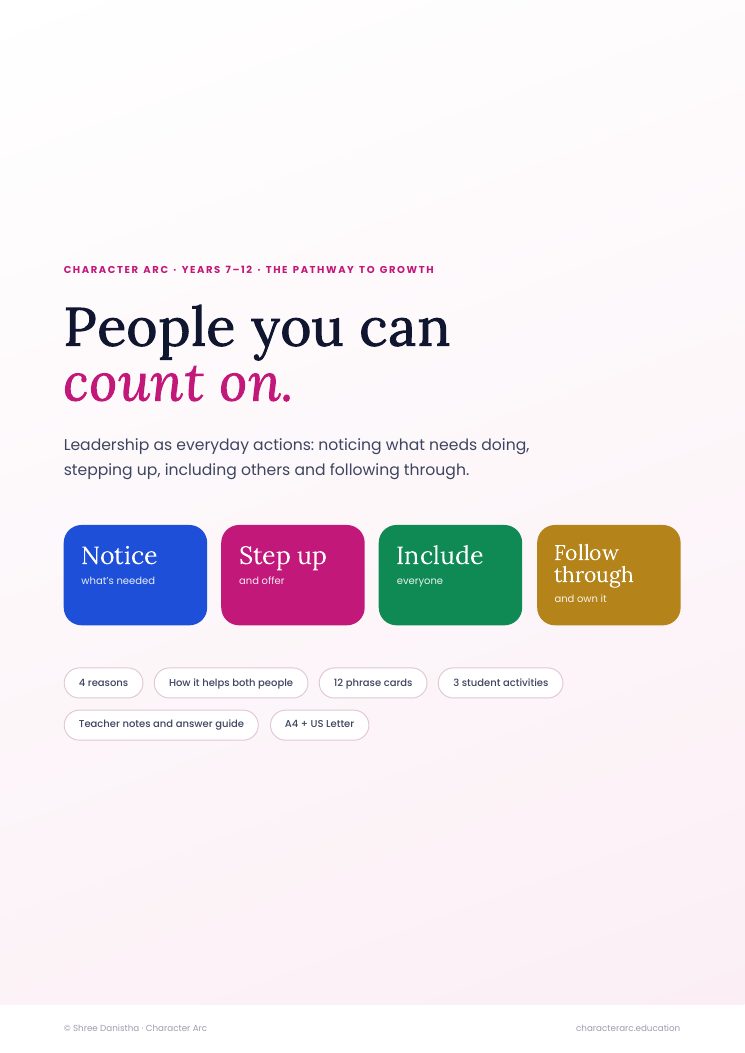
Leadership as everyday actions: noticing what needs doing, stepping up, including others and following through. Written for young people in Years 7 to 12.
The four steps

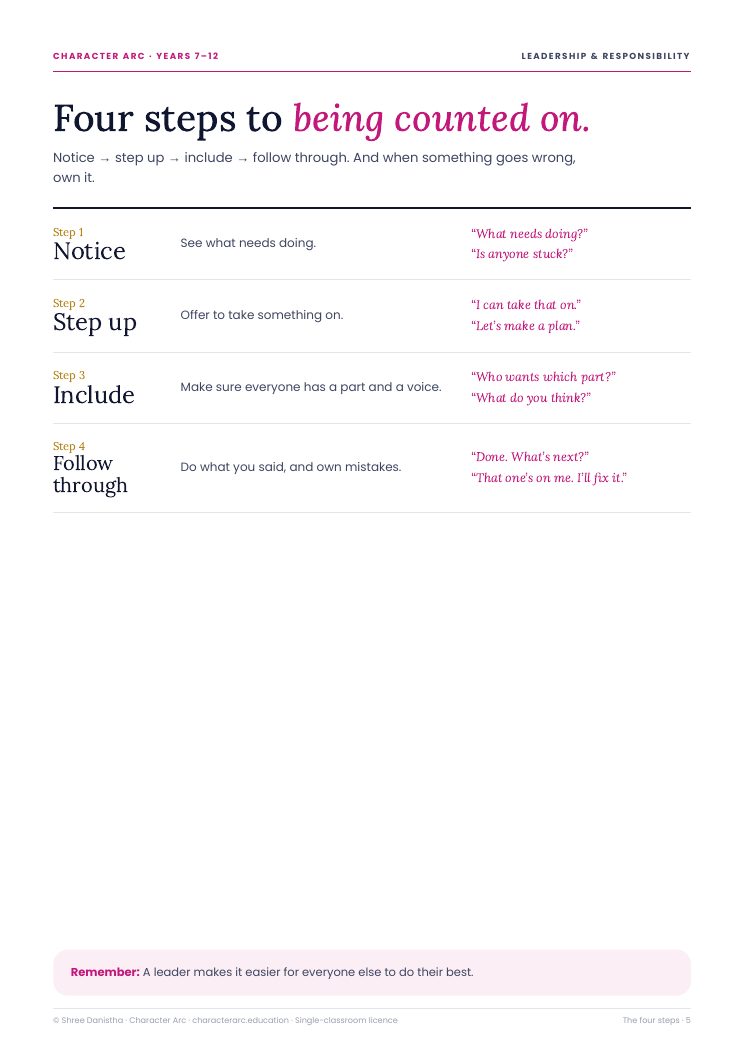
Four steps to being counted on.

Notice → step up → include → follow through. And when something goes wrong, own it.

Step 1

Notice

See what needs doing.

  • “What needs doing?”
  • “Is anyone stuck?”
Step 2

Step up

Offer to take something on.

  • “I can take that on.”
  • “Let’s make a plan.”
Step 3

Include

Make sure everyone has a part and a voice.

  • “Who wants which part?”
  • “What do you think?”
Step 4

Follow through

Do what you said, and own mistakes.

  • “Done. What’s next?”
  • “That one’s on me. I’ll fix it.”

RememberA leader makes it easier for everyone else to do their best.

Why it matters

Why step up?

Leadership isn’t a badge or a title. It is a set of small actions that anyone can take, every day.

i.

Leadership is action, not a title

Anyone can lead by noticing what needs doing and helping others do it.

ii.

Responsibility builds trust

When people know you will do what you say, they rely on you and include you.

iii.

Groups need someone to start

Often everyone is waiting for someone else. One person stepping up gets things moving.

iv.

It grows confidence

Every time you follow through, you prove to yourself that you can.

How it helps everyone

Good for one person. Better for both.

This skill is not only good for the person who uses it. It helps everyone involved, and the relationship between them.

For the one who steps up

  • Builds confidence
  • Earns trust
  • Learns to plan and organise
  • Becomes someone people rely on

For the group

  • Gets things done
  • Everyone has a role
  • Feels supported
  • Knows what’s happening

For everyone

  • Stronger teams
  • Fewer things forgotten
  • Shared success
  • Others start stepping up too
The words to use

Phrases young people can actually say.

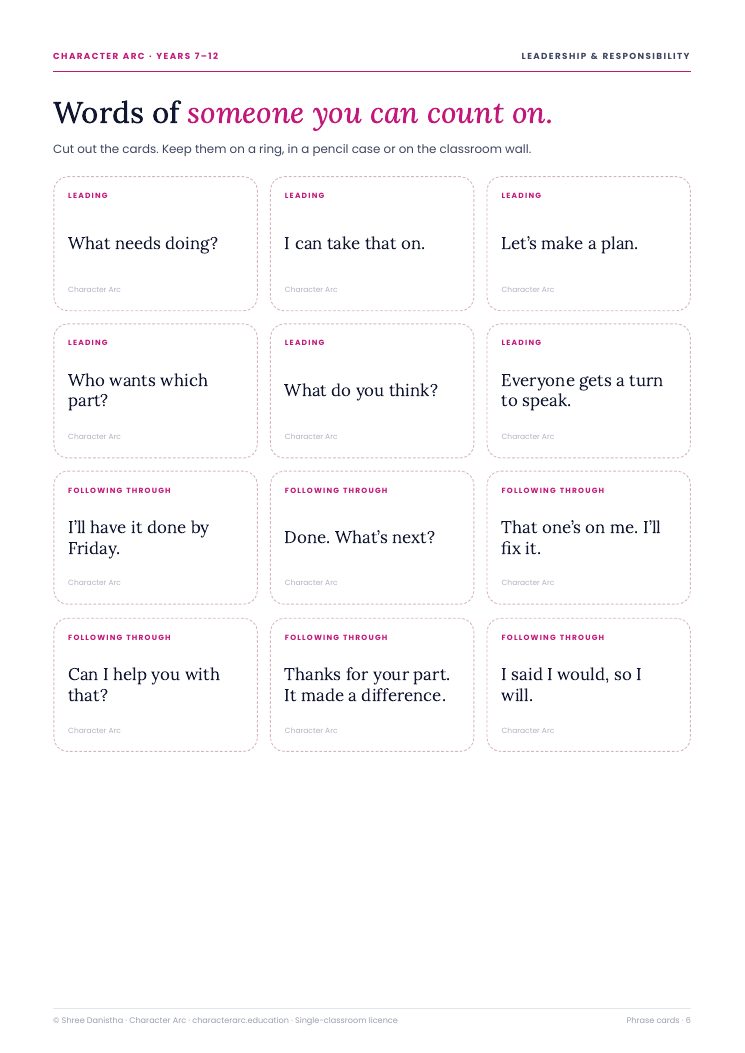
The pack includes twelve cut-out phrase cards. Here are some of them.

Leading
  • What needs doing?
  • I can take that on.
  • Let’s make a plan.
  • Who wants which part?
  • What do you think?
  • Everyone gets a turn to speak.
Following through
  • I’ll have it done by Friday.
  • Done. What’s next?
  • That one’s on me. I’ll fix it.
  • Can I help you with that?
  • Thanks for your part. It made a difference.
  • I said I would, so I will.
At home and in class

How to use it.

Each activity takes about 15–20 minutes. Use the pack in a single lesson, in pastoral care or tutor group, or over a week at home.

Three activities, all built on fictional scenes:

  • 1Who could step up?
  • 2Rewrite the group.
  • 3Leading well, or not yet?
Safety note. Responsibility means doing your part. It does not mean carrying everything alone. Students should know that asking an adult for help is part of being responsible, especially if a situation feels too big or unsafe.
  1. Teach it calmlyIntroduce the four steps when everyone is settled, not in the middle of a conflict.
  2. Model the wordsUse the phrases yourself. Young people copy what they see and hear.
  3. Role-play the scenesAct out the fictional scenes in pairs, then swap roles.
  4. Keep the cards closePut the phrase cards on the wall, on a ring or in a pencil case.
  5. Rotate the rolesGive every student a turn at a small leadership role, such as timekeeper, organiser or materials manager, so leadership is something everyone practises, not just a few.
What’s included

People you can count on.

Years 7–12 · 11 pages · A4 and US Letter

Leadership & responsibility

A print-and-go pack for home, classroom and pastoral care.

Inside
Teacher and parent notes, four reasons why it matters, how it helps everyone, the four steps, 12 phrase cards, three activities and an answer guide
Privacy
Every activity uses fictional characters. Students never describe their own lives.
Format
Printable PDF, A4 and US Letter
Private by design
Practise the skill with fictional scenes. Use it in real life.

Every activity in this pack uses made-up characters and everyday situations, so young people can practise without sharing anything personal.

Ways to join

School licences & private membership.

Character Arc is available to schools and to families. Choose the way that suits you, and Shree will be in touch personally.

For schools

School licences available

Bring the pathways into your classrooms with one shared language for calm, clear words, character, feelings and connection.

  • Classroom licences
  • Whole-school licences
Enquire about a licence →
For families

Private website membership

A private membership to the Character Arc website for families who want to follow the pathways at home, at their child’s own pace.

  • Private access for your family
  • Set up personally by Shree
Enquire about membership →